Simple Addition on the Soroban: A Parent's Complete Guide to Teaching Your Child
Learn exactly how to teach simple addition on the soroban abacus with step-by-step instructions, real examples, and practice exercises. From a dad who taught two kids soroban at home.
When my daughter Emma was 5, she was terrified of math. Numbers made her cry. Fast forward two years: she now does three-digit addition in her head faster than I can type it into a calculator. The secret? A simple wooden tool called the soroban. Addition on the soroban became the gateway that transformed both my kids from math-anxious to math-confident. In this comprehensive guide, I'll share exactly how I taught simple addition – the same method that thousands of Japanese children have used for generations.
Why Start With Addition on the Soroban?
Before we dive into technique, let me explain why soroban addition is fundamentally different from traditional math instruction. When children learn addition in school, they're memorizing abstract symbols. 2 + 3 = 5 is just a fact to remember. On the soroban, addition is visible, tangible, and logical. Your child literally sees two beads combine with three beads to make five.
This visual-tactile approach builds genuine number sense. My son James, who struggled with traditional math homework, suddenly understood what numbers meant after just one week of soroban practice. He told me, 'Dad, I can see the numbers now.' That moment made every minute of our practice sessions worthwhile.
Research from Kyoto University shows that children who learn arithmetic on the soroban develop stronger activation in the brain's visual-spatial regions. They're not just memorizing – they're building mental models of numbers.
The Golden Rule of Soroban Addition
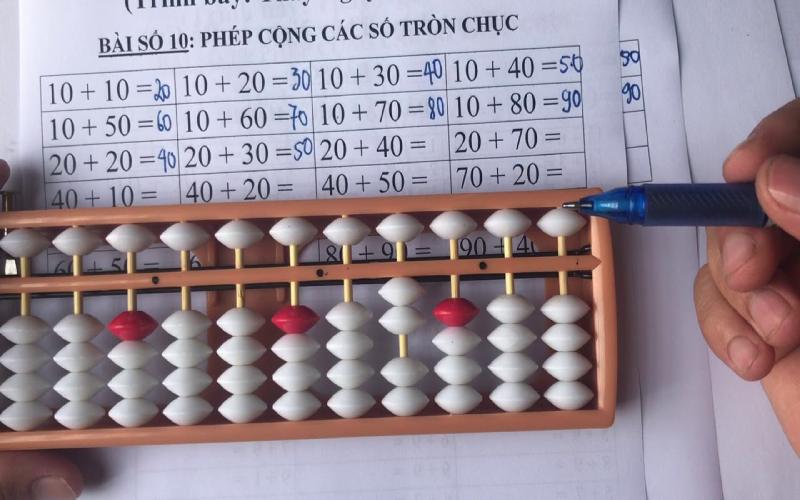
Before teaching your child a single problem, make sure they understand this one principle: To add on the soroban, move beads TOWARD the beam. That's it. Every addition operation follows this rule.
- •Lower beads (earth beads): Push UP toward the beam using your thumb
- •Upper bead (heaven bead): Push DOWN toward the beam using your index finger
- •Beads touching the beam = counted: Everything else is zero
I spent the first session with Emma just playing 'bead games.' Can you push this bead toward the beam? Now push it away. Which beads are we counting? This foundation made actual addition effortless.
Understanding the Value System
Make sure your child understands the value of each bead before attempting addition. I created a little rhyme for my kids that helped them remember.
"Earth beads count by one, Heaven bead is worth five, Push them to the beam to make numbers come alive!" This simple rhyme helped both my kids remember bead values instantly.
- •Each lower bead (earth): Worth 1 when touching the beam
- •The upper bead (heaven): Worth 5 when touching the beam
- •Maximum per column: 5 + 4 = 9 (one heaven + four earth)
- •Beads away from beam: Worth nothing (cleared state)
Your First Addition Problem: 2 + 3
Let's start with the classic beginner problem. I chose this for Emma because it uses only lower beads – no heaven bead complications yet.
- •Step 1: Clear the soroban (all beads away from beam)
- •Step 2: Set the number 2 – push TWO lower beads UP toward the beam using your thumb
- •Step 3: Now add 3 – push THREE MORE lower beads UP toward the beam
- •Step 4: Count the beads touching the beam: 1, 2, 3, 4, 5
- •Step 5: Answer: 5 beads at the beam means the answer is 5
The first time Emma did this correctly, her eyes lit up. 'I can SEE the five!' she said. That's the magic of soroban – math becomes visible.
Second Problem: 3 + 1
Once your child masters 2+3, try another simple combination. This builds confidence through repetition.
- •Step 1: Clear the soroban completely
- •Step 2: Set 3 – push THREE lower beads up with your thumb
- •Step 3: Add 1 – push ONE more lower bead up
- •Step 4: Read the result: 4 beads at the beam = 4
Notice we're keeping all answers at 4 or less initially. This means only lower beads are used – we haven't introduced the heaven bead yet. One concept at a time!
More Practice Problems (Lower Beads Only)
Have your child work through these problems before introducing the heaven bead. Each one should take less than a minute once they understand the process.
- •1 + 1 = 2 (Two beads up)
- •1 + 2 = 3 (Three beads up)
- •2 + 2 = 4 (Four beads up)
- •1 + 3 = 4 (Four beads up)
- •2 + 1 = 3 (Three beads up)
James wanted to rush ahead to bigger numbers. I had to remind myself (and him) that mastery at this stage pays dividends later. We spent three full sessions on just these five problems before moving on.
Introducing the Heaven Bead: 4 + 1
Now comes the first 'trick' – and it's actually beautiful once you understand it. What happens when you have 4 lower beads and need to add 1 more, but there are no more lower beads?
- •Step 1: Set 4 – push ALL FOUR lower beads up to the beam
- •Step 2: Try to add 1... but there's no room! All lower beads are used
- •Step 3: Here's the magic: Push all 4 lower beads DOWN, push the heaven bead DOWN
- •Step 4: Result: Heaven bead at beam = 5
Emma struggled with this at first. Then I explained it differently: 'Four pennies PLUS one penny equals ONE nickel. We're trading coins!' That clicked for her immediately.
The 4+1=5 exchange is called the '5-complement.' It's one of the most important concepts in soroban. Make it fun: 'Clear four, add five!' Kids love the rhythm.
More Heaven Bead Problems
Once your child masters 4+1, introduce these problems that use both earth and heaven beads.
- •5 + 1 = 6 (Heaven bead already down, add one lower bead)
- •5 + 2 = 7 (Heaven bead down, add two lower beads)
- •5 + 3 = 8 (Heaven bead down, add three lower beads)
- •5 + 4 = 9 (Heaven bead down, add four lower beads)
- •6 + 1 = 7 (Heaven + 1 already showing, add one more lower)
- •6 + 2 = 8 (Heaven + 1 showing, add two lower beads)
These problems feel natural once children understand that the heaven bead represents five. James started calling it the 'five bead' which honestly makes more sense than 'heaven bead'!
The Proper Finger Technique
Getting finger technique right early prevents bad habits later. I learned this the hard way with Emma – we had to re-learn proper technique after she developed an awkward grip.
- •Thumb: Used ONLY to push lower beads UP (toward the beam)
- •Index finger: Used to push lower beads DOWN and to move the heaven bead both ways
- •Other fingers: Curled naturally, not involved in bead movement
- •Wrist: Relaxed, fingers do the work, not the arm
Many beginners want to use their index finger for everything. Gently correct this. Thumb-up, index-down becomes automatic with practice and enables much faster calculation later.
Setting Up for Success: The Practice Environment
Where and how you practice matters as much as what you practice. Here's what worked for our family.
- •Consistent time: We practiced right after breakfast, every day, no exceptions
- •Clear workspace: Table clear of distractions, good lighting
- •Short sessions: 10-15 minutes maximum for beginners
- •End on success: Always finish with a problem they can solve confidently
- •No screens nearby: Phone and tablet completely out of sight
The Sorokid app helped us maintain consistency. Its built-in timer and progress tracking turned practice into a game. Emma actually looked forward to 'soroban time' – something I never expected from a child who once cried at math worksheets.
Common Mistakes and How to Fix Them
After teaching both my kids and helping several neighbor children, I've seen the same mistakes repeatedly. Here's how to address them.
- •Counting beads individually: Encourage seeing groups (two beads = 2, not 'one, two')
- •Wrong finger technique: Gently correct, don't scold – bad habits form when kids feel judged
- •Rushing through problems: Speed comes naturally, accuracy must come first
- •Not clearing completely: Always reset to zero before the next problem
- •Forgetting heaven bead value: Remind them regularly: heaven bead = 5
Verbal Cues That Help
Speaking problems aloud builds stronger mental connections. I developed these verbal patterns with my kids.
- •'Set two' (push beads) 'Add three' (push more) 'Read five' (count result)
- •'Clear, set, add, read' – the four-step rhythm
- •'Four goes down, five comes down' – for the 4+1 exchange
- •'Check the beam!' – reminder to count only beads at the beam
Eventually, your child will internalize these verbal cues. That's when mental math begins – they'll visualize the soroban and 'hear' the steps in their head.
Week-by-Week Learning Plan
Here's the exact schedule I used with both Emma and James. Adjust based on your child's pace.
- •Week 1: Bead values and reading numbers 1-9 only
- •Week 2: Addition with sums under 5 (1+1, 1+2, 2+2, etc.)
- •Week 3: The 4+1=5 exchange, addition with sums of exactly 5
- •Week 4: Addition with sums 6-9, using heaven bead combinations
- •Week 5: Mixed problems, building speed and confidence
Emma needed an extra week at Week 3 – the exchange concept was hard for her. James flew through but struggled with Week 4. Every child is different. Trust the process.
Celebrating Progress
Recognition motivates continued practice. We created simple celebrations for milestones.
- •First correct answer: High five and specific praise ('You moved the beads perfectly!')
- •5 problems in a row: Sticker on their progress chart
- •Mastering the 4+1 exchange: Extra dessert after dinner
- •Completing all single-digit addition: Their choice of weekend activity
The Sorokid app has built-in achievement badges that my kids loved collecting. Digital rewards actually worked better than my sticker chart for James – he's more tech-motivated than Emma.
What Comes After Simple Addition?
Once your child confidently solves single-digit addition, you're ready for the next steps.
- •Two-digit addition: Same concepts, using multiple columns
- •The 10-complement: What happens when a column fills up (9+1 situation)
- •Speed drills: Building automaticity through timed practice
- •Mental visualization: Calculating without touching the soroban
- •Subtraction: The natural partner to addition
Both my kids hit a natural 'plateau' after about two months where progress seemed to stop. Then suddenly, everything clicked and they jumped to the next level. Be patient during these plateaus – the brain is consolidating.
The Long-Term Impact
Emma is now 8. She recently helped her older cousin with multiplication homework – something that would have been unthinkable three years ago. James, at 6, has the math confidence of a second-grader. Neither of them fear numbers anymore.
The soroban didn't just teach them addition. It taught them that math is learnable, that they're capable of understanding numbers, and that practice leads to mastery. Those lessons extend far beyond arithmetic.
Studies show children who learn soroban demonstrate improved performance in school math, stronger working memory, and enhanced concentration abilities. The investment you make in simple addition today pays dividends for years.
My Advice to Parents Just Starting
If I could go back and give myself advice before starting this journey with Emma, here's what I'd say.
- •Start slower than you think: Mastery beats speed every time
- •Make it daily: 10 minutes every day beats an hour once a week
- •Learn alongside your child: Your interest motivates them
- •Expect frustration: It's part of learning, not a sign of failure
- •Trust the process: Thousands of children have learned this way
- •Celebrate small wins: Every correct answer is progress
Simple addition on the soroban is just the beginning. But it's the foundation for everything that follows. Get this right, and you'll have given your child a gift that lasts a lifetime.
Ready to help your child master soroban addition? Sorokid offers interactive lessons, step-by-step guidance, and progress tracking designed for busy families.
Start Free Trial